
Description
Luxman D-100 Centennial
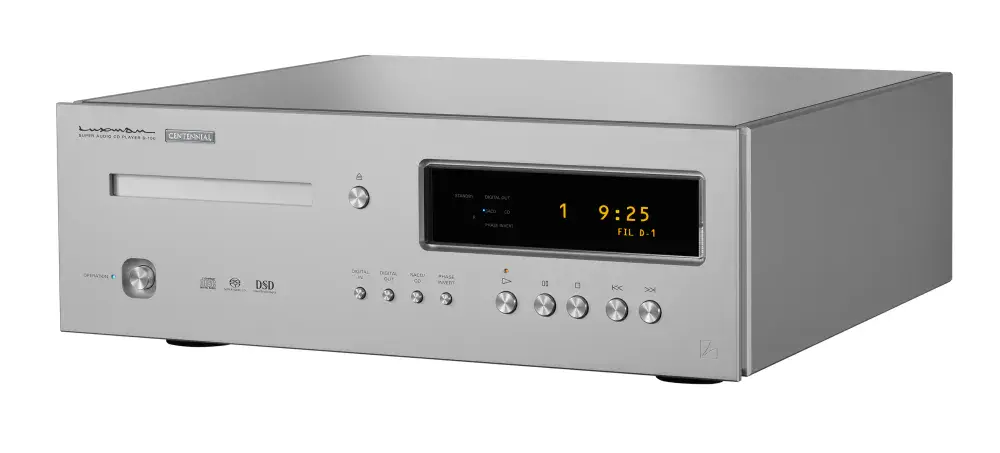
The Luxman D-100 Centennial is LUXMAN’s flagship SACD/CD player and external DAC, created to mark the company’s 100th anniversary and to succeed the D-10X as the definitive expression of disc-based playback. It combines a fully rebuilt proprietary disc transport, dual-mono ROHM reference DAC chips, and the latest-generation LIFES 1.1 analogue output circuitry into a single, uncompromising source component. Weighing 25.4 kg and drawing on a century of amplifier and analogue design expertise, the D-100 Centennial is built for listeners who place disc playback at the center of a high-end system.
Position Within the LUXMAN Lineup
The D-100 Centennial sits at the very top of LUXMAN’s digital source hierarchy, forming part of the Centennial series alongside the L-100 Centennial integrated amplifier and the P-100 Centennial headphone amplifier. All three models carry the commemorative chrome “CENTENNIAL” nameplate and share the same chassis design language as the reference C-10X and M-10X separates. The D-100 Centennial replaces the D-10X, which launched in 2020, and represents a ground-up redesign rather than an incremental update, with a new transport mechanism, new DAC devices, upgraded clocking, and a first-in-class deployment of the LIFES 1.1 analogue output engine in a disc player.
LxDTM-i Disc Transport Mechanism
LUXMAN engineered its own disc transport for the D-100 Centennial rather than adapting an off-the-shelf mechanism. The proprietary LxDTM-i (Luxman original Disc Transport Mechanism, improved) encloses the rotating mechanism in a rigid box structure built from 8mm-thick aluminum side frames, a 5mm-thick steel top plate, and a newly added 8mm-thick aluminum base plate. The transport is directly integrated into the main chassis rather than floating independently, creating a unified structure that isolates the mechanism from external vibrations with exceptional rigidity.
Following the approach established on the D-10X, the mechanism is positioned on the left side of the chassis, freeing the right side for the full-scale analogue output circuitry and enabling the shortest possible signal path from disc to output. Wiring routes have been re-optimized to match the updated circuit layout. The disc tray features a dust-proof shutter that closes when the drawer is open, protecting the mechanism and contributing to the quiet, composed operation expected at this level.
Reference-Class Digital Processing
DAC Configuration
Digital-to-analogue conversion is handled by a pair of ROHM BD34302EKV DAC chips, each operating in monaural mode to deliver a true dual-mono configuration. The BD34302EKV is ROHM’s current reference-grade device, and LUXMAN has incorporated newly available sound-quality enhancement logic at the IC level alongside thorough optimization of the surrounding analogue circuitry. The result is a significant performance step over the conversion stage found in the D-10X.
USB Playback
Via the USB input, the D-100 Centennial supports PCM at sampling rates from 44.1 kHz up to 768 kHz at 16, 24, and 32-bit word lengths, and DSD from 2.8 MHz through 22.5 MHz (DSD512). Beyond the standard isochronous USB transfer mode, users can install LUXMAN’s dedicated Windows driver software to enable Bulk Pet transfer across four configurable modes. Bulk Pet equalizes processing load, reduces interference from USB bus noise, and is widely regarded as an audible improvement over isochronous communication in high-resolution USB audio delivery.
S/PDIF Inputs and Outputs
For sources other than USB, the D-100 Centennial accepts coaxial and optical S/PDIF signals carrying PCM up to 192 kHz at 16, 20, and 24-bit, as well as 2.8 MHz DSD via DoP. Coaxial and optical digital outputs are also provided, allowing the built-in LxDTM-i transport to feed an external DAC or processor in PCM format.
Filter and Mode Options
Three digital filter options are available for PCM playback and two for DSD playback, allowing listeners to select the tonal presentation that best suits their system and preferences. These filters are accessible via the front panel and remote control.
LIFES 1.1 analogue Output Stage
The analogue output stage of the D-100 Centennial marks the first time LUXMAN’s LIFES amplification feedback engine has appeared in a disc player. LIFES (Luxman Integrated Feedback Engine System) is the successor to ODNF, LUXMAN’s long-standing amplifier feedback technology. Where conventional negative feedback degrades signal quality in the process of correction, LIFES isolates and feeds back only the distortion components generated during amplification, leaving the original audio signal intact. The D-100 Centennial implements LIFES version 1.1, which further reduces distortion by parallel-connecting the input stage of the differential detection amplifier. THD figures confirm the result: 0.0016% for CD, 0.0007% for SACD, and 0.0006% via USB, with an S/N ratio of 125 dB across all inputs.
The output stage is fully balanced from end to end, with analogue output available via Neutrik-manufactured XLR terminals and LUXMAN’s own high-rigidity RCA terminals mounted at a generous 22mm pitch to accommodate large audiophile cable connectors. Unbalanced output voltage is 2.4V at 300 ohms; balanced output is 2.4V at 600 ohms, with SACD and DSD sources outputting at 2.3V.
Power Supply and Construction
The power supply uses a CI-core transformer with independent left and right channel rectification circuits, dedicated regulators, and a bank of high-capacity filter capacitors totaling 40,000µF. This topology provides clean, stable power to each channel independently. All circuit boards for signal-path stages use peel-coat PCB technology, which eliminates resistive coatings that can introduce noise and degrade low-level signal integrity. Internal wiring is OFC (oxygen-free copper) throughout.
The chassis employs a composite construction combining a main structural body with a shielded inner chassis to reduce ground impedance and suppress magnetic interference. The unit is supported by four cast-iron density-gradient insulator feet, which isolate it from surface-borne vibrations and damp internal resonances that would otherwise reach the transport and analogue circuitry.
Clocking and Jitter Reduction
Two independently developed clock circuits are employed, each pairing an ultra-low phase-noise oscillator IC with a large crystal oscillator. This combination reduces broadband noise around the oscillation frequency and achieves extremely low jitter. For USB playback, asynchronous communication is managed by a dedicated DSP that controls timing independently of the host computer. For S/PDIF inputs, LUXMAN’s proprietary DAIR (Digital Audio Intelligent Reclocking) system provides high-accuracy clock management, ensuring stable signal reconstruction regardless of the jitter characteristics of the source.
Display, Controls, and Connectivity
The front panel features a newly developed large high-definition OLED display that is approximately 70% larger than the display used on the D-10X. Track information, elapsed time, source format, filter mode, and playback status are all clearly presented. A four-level dimmer function, a 4x zoom mode for long-distance visibility, and automatic brightness reduction are included. The front panel input selector, operation controls, cartridge selector for MM/MC phono sources, and the LECUA volume control are clearly labeled and logically arranged.
The AC inlet has been redesigned with a reversed mounting orientation to support the weight of heavy power cables without flex or movement, maintaining a stable mechanical connection. A slim premium aluminum remote control with numeric keypad (model RD-21) is included and is also compatible with compatible LUXMAN CD players and components. Trigger input and output terminals (12V) and control input/output terminals allow integration with compatible LUXMAN components using standard 3.5mm monaural mini jack cables.
Centennial Series Context
LUXMAN was founded in 1925 in Japan and reached its 100th anniversary in 2025. The Centennial series was developed specifically to mark this milestone, with each model in the range incorporating the most advanced version of LUXMAN’s core technologies at the time of production. The D-100 Centennial is not positioned as a limited or commemorative edition in the collector sense; rather, it represents LUXMAN’s current-production reference for disc playback and is intended as a long-term part of the company’s flagship lineup, built to be owned and used for decades. The glossy chrome “CENTENNIAL” nameplate on the front panel signals this status, as does the shared design language with the C-10X and M-10X reference separates that anchor LUXMAN’s top-tier amplification range.
The Luxman D-100 Centennial is a comprehensive statement on what physical media playback can achieve when every element of the chain, from the transport mechanism through the clocking, conversion, and analogue output stages, is designed without compromise.
Specifications
- Supported Discs: 2-channel SACD, CD
- D/A Converter: ROHM BD34302EKV (monaural mode) x2, dual-mono configuration
- USB Input (PCM): 44.1 / 48 / 88.2 / 96 / 176.4 / 192 / 352.8 / 384 / 705.6 / 768 kHz, 16/24/32-bit
- USB Input (DSD): 2.8 / 5.6 / 11.2 / 22.5 MHz (1-bit)
- Coaxial / Optical Input: 44.1 / 48 / 88.2 / 96 / 176.4 / 192 kHz (16/20/24-bit); 2.8 MHz DoP
- analogue Output Voltage / Impedance: Unbalanced: 2.4 V / 300 Ω; Balanced: 2.4 V / 600 Ω; SACD/DSD: 2.3 V
- Frequency Response: CD/Coaxial/Optical: 5 Hz to 20 kHz (+0, -0.5 dB); SACD: 5 Hz to 38 kHz (+0, -3.0 dB); USB: 5 Hz to 58 kHz (+0, -3.0 dB)
- Total Harmonic Distortion: CD: 0.0016%; SACD: 0.0007%; USB: 0.0006%
- S/N Ratio (IHF-A): CD: 125 dB; SACD: 125 dB; USB: 125 dB
- Disc Transport Mechanism: LxDTM-i (Luxman original Disc Transport Mechanism, improved)
- Amplification Feedback Circuit: LIFES 1.1
- Power Supply: 230 V~ (50 Hz) / 115 V~ (60 Hz)
- Power Consumption: 44 W
- Dimensions (W x H x D): 440 x 154 x 420 mm (front knob adds 2 mm; rear terminals add 13 mm to depth)
- Net Weight: 25.4 kg
- Accessories: Remote control (RD-21), power cable
Reviews
There are no reviews yet.